
SMARTDEC policy recommendations for maritime transport and port decarbonisation
The SMARTDEC project releases its policy recommendations to support the decarbonisation of maritime transport and ports, providing concrete proposals for policymakers at Atlantic and European levels.The SMARTDEC project has released its policy recommandations, a key deliverable translating project results into concrete proposals for policymakers, supporting the decabonisation of maritime transport and ports at Atlantic and European levels.
Recommendations built on project work
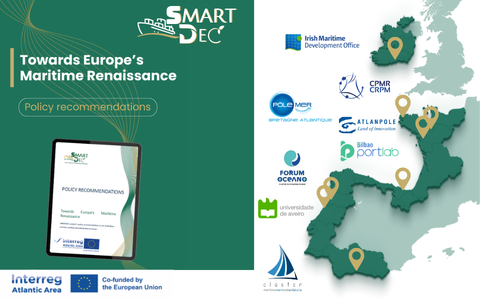
Developed under Work Package 5 – SMARTDEC Impact & Legacy from regional to EU Level, the policy recommendations were produced by the Conference of Peripheral Maritime Region (CPMR), a project partner, with contributions from the entire consortium: Pôle Mer Bretagne Atlantique, Atlanpole, Maritime-Marine Cluster of Andalusia (CMMA), Irish Maritime Development Office, University of Aveiro, Forum Oceano and Bilbao Port Lab.
They are based on:
- results achieved at this stage of the project,
- insights gathered from regional workshops,
- contributions and feedback from project partners.
Supporting the implementation of EU maritime strategies
The SMARTDEC policy recommendations are operational project-level recommendations, focusing on maritime decarbonisation and innovation ecosystems. They aim to define how upcoming EU maritime industry and ports strategies can be effectively implemented.
They highlight how regional stakeholders and local ecosystems can contribute to European industrial sovereignty and the green transition, while supporting innovation developed in Europe.
Inputs to EU maritime industry policy
The recommendations are aligned with key orientations of the future EU maritime industry strategy, including:
- mapping industrial capacities,
- supporting research and innovation flagship initiatives,
- strengthening links with regional Smart Specialisation Strategies and the Blue S3 Platform,
- promoting EU preference in procurement,
- and supporting the use of ETS revenues for maritime decarbonisation projects.
They also emphasise the importance of:
- coordinating testing centres and innovation infrastructures,
- simplifying administrative procedures,
- and ensuring continuity in EU research and innovation projects.
In addition, the recommendations highlight the need to address maritime emissions across the full emissions cycle and to strengthen coordination between innovation actors at European level.
Inputs to EU ports policy
The SMARTDEC recommendations also contribute to reflections on EU ports policy by highlighting:
- the importance of port digitalisation,
- their role as energy transition hubs,
- and the need to strengthen cooperation between ports, industrial clusters and regional authorities.
They also underline:
- the need to improve access to finance for ports of all sizes,
- the importance of deploying advanced energy management solutions,
- and the role of ports in coordinating energy use across their ecosystems.
The concept of “Maritime Industry Valleys”
The policy recommendations explore the concept of “Maritime Industry Valleys”, presented as a tool to support a coordinated and effective implementation of initiatives for the decarbonisation of maritime transport and ports.
This concept promotes stronger coordination between laboratories, testbeds, innovation hubs and pilot infrastructures, in order to support open innovation and accelerate the deployment of solutions.
Download the policy recommendations
the full document is available here: D5.2 – SMARTDEC Policy Recommendations – SMARTDEC
Go further
The SMARTDEC Community platform, developed as part of the project, aims to foster exchanges between stakeholders and support knowledge sharing on the decarbonisation of maritime transport and ports.
Join the SMARTDEC Community ! : Register here | SMARTDEC Community